


Green Revolution of Multi-core Cables: Five Innovative Paths to Solve Environmental Problems
Breakthrough technologies for recycling discarded cables are turning electronic waste sites into new mines for the circular economy.
As the “nerves and blood vessels” of modern industry, multi-core cables support the interconnection of global electronic devices, from household appliances to industrial robots, from data centers to new energy systems. With the acceleration of the replacement of electronic products, the environmental pressure brought by discarded cables has become increasingly prominent – the polyvinyl chloride (PVC) materials of traditional cables are difficult to degrade, and the harmful substances released after landfill can pollute the soil for decades.
The Chinese market alone produces more than 2 million tons of discarded wires and cables each year, of which only 35% are recycled in a standardized manner.
Under the global carbon neutrality goal and the wave of circular economy, the multi-core cable industry is undergoing a silent revolution: From material innovation, process upgrades to recycling technology breakthroughs, green transformation has become the core proposition of industry development. Leading companies have proved that environmental protection and performance can be achieved at the same time, and sustainable development is transforming from a cost burden to an innovation driver.
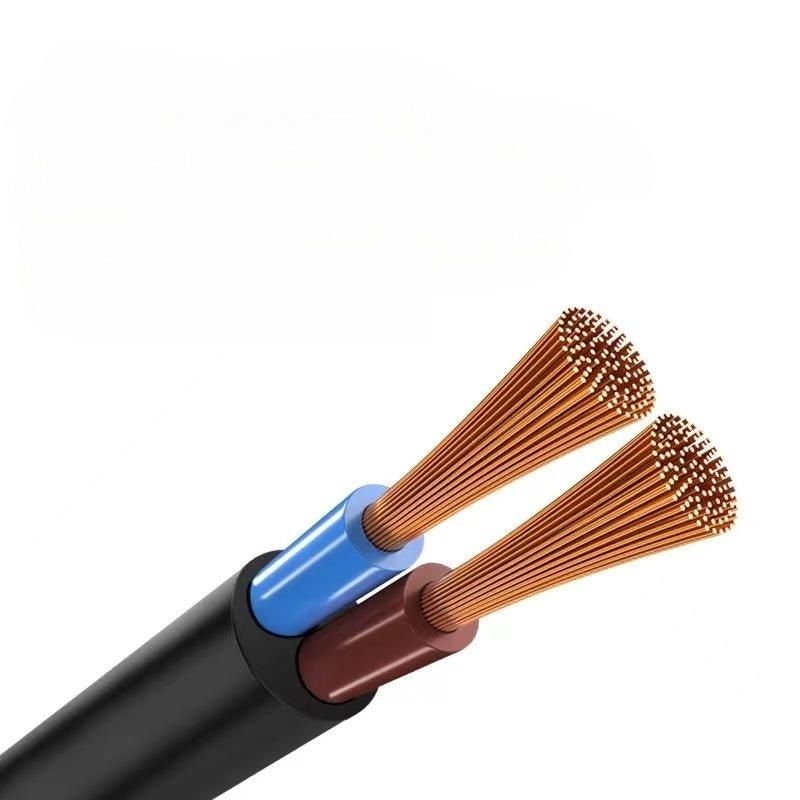
Material innovation: Performance breakthrough of environmentally friendly substrate
PVC insulation materials of traditional multi-core cables face a double dilemma: toxic chlorine compounds are released during the production process, and dioxins and other carcinogens are produced when waste is incinerated. The industry is overcoming this problem through molecular design.
Environmentally friendly polymers lead the change. The application of modified TPU materials in Aipuda low-temperature resistant cables enables the products to remain flexible in extreme environments of -60℃, and the resistance change rate is controlled within 3%, far exceeding the performance limit of traditional PVC materials [-40℃/-60℃ multi-core low-temperature resistant control cables have been successfully used in Russian Arctic oil and gas projects].
Guangdong Shouyi Wire and Cable has developed a recyclable new polymer sheath, which does not release harmful gases during the entire production process and can be efficiently recycled after being discarded, reducing resource consumption from the source [its multi-core sheathed wire uses a recyclable, pollution-free new polymer].
High-end materials expand application scenarios. DuPont ETFE 207 material from the United States has opened up the high-end market with its excellent properties: temperature resistance ranges from -200℃ to 150℃, chemical resistance to strong acid and alkali corrosion, friction coefficient as low as 0.2, and weight reduction of 30% in the field of aerospace cables [ETFE DuPont 207 injection molding grade material has many unique properties]. Although the initial cost is three times that of PVC, the service life of more than 25 years significantly reduces the cost of the entire life cycle.
Green Manufacturing: A Production Revolution of Energy Saving and Consumption Reduction
The wire and cable industry used to be a major energy consumer, but now it has greatly reduced its carbon footprint through technological innovation. Smart production lines reshape efficiency benchmarks. Jinlongyu Group introduced the Swiss Melafell automated production line, which increased the yield of PU multi-core cables from 82% to 97%, and reduced the labor cost per kilometer of products by 65% [the automated production line reduced the labor cost per kilometer of cable by 65%].
Jiangsu Hengtong’s “dark light factory” has saved more than 200 million yuan in labor costs through intelligent transformation, confirming the synergy between high-end manufacturing and green transformation.
Process innovation reduces emissions. Zhujiang Cable has reduced the thickness of the insulation layer by 20% without affecting performance by optimizing the extrusion process, and single production line saves more than 50 tons of raw materials per year [adopting efficient and energy-saving production processes to reduce energy consumption and emissions].
Changzhou Anite uses environmentally friendly PVC formula in the production of UL2586 multi-core power cables, which fully complies with the RoHS directive, with heavy metal content below 900ppm, breaking through the EU green barrier [using environmentally friendly materials and complying with the ROHS directive].
Recycling technology: a recycling path to turn waste into treasure
Abandoned cable landfills are transforming into “urban mines”. Mechanical recycling has achieved a qualitative leap. Anhui Lisheng Recycling Resources uses airflow sorting technology to achieve a copper-plastic separation purity of 99.2%, and a metal recovery rate that is 40% higher than the traditional incineration method [treatment methods for waste wires and cables].
Baoding Yufa’s eddy current sorting system processes 5 tons of mixed cables per hour, accurately sorts copper and aluminum by magnetic permeability differences, and completely solves the efficiency bottleneck of manual peeling [using mechanical crushing and physical crushing methods].
Chemical method opens up new ways. Low temperature freezing crushing technology immerses the cable in a -196℃ liquid nitrogen environment, embrittles the insulation material and then mechanically crushes it to avoid metal oxidation, recovering copper with a quality close to that of the original ore [physical crushing includes low temperature freezing crushing].
The catalytic pyrolysis technology developed by a leading German company converts plastic sheaths into fuel oil, realizing the transformation from waste to energy.
Policies and standards: accelerators of green transformation
Regulations and standards are strongly driving industry change. International directives force upgrades. The EU RoHS directive continues to upgrade, requiring the halogen content of cables to be less than 900ppm after 2027, forcing Chinese companies to eliminate bromine-containing flame retardants [EU RoHS directive upgrades, requiring the halogen content of cables to be less than 900ppm].
The US UL certification incorporates the MTW (machine tool wire) standard into the UL2586 certification, allowing Changzhou Anite’s multi-core power cables to meet the stringent requirements of the industrial machinery field in terms of oil resistance and flame retardancy [MTW standards comply with UL, 1063, UL83].
Domestic policies provide momentum. Made in China 2025 lists special cables as a key development area, and government procurement gives priority to domestic environmentally friendly products. As a result, Jinyou Jinhong’s PU cables have won a large order from CATL, and the localization rate has increased by 40% in three years** [Made in China 2025 lists special cables as a key development area].
The “honeycomb shielding layer” technical standard formulated by the Shanghai Cable Research Institute reduces the operating temperature of multi-core cables by 15°C and significantly improves energy efficiency.
Ecological closed loop: from single-point breakthrough to system coordination
True sustainability requires collaboration across the entire industry chain. Extended producer responsibility implementation. Zhujiang Cable has established a recycling alliance network, set up special recycling bins in 20 cities, and increased the recycling rate by 30% through the “old for new” policy [establishing a complete cable recycling system].
Aipuda uses the Shanghai Free Trade Zone as a hub and has established an emergency spare parts warehouse in Tromsø, Norway to provide waste cable recycling services for Nordic customers, forming a transnational recycling network[establishing a service system covering the extremely cold regions of Northeast Asia and Northern Europe].
Green design runs through the entire cycle. Guangdong Shouyi’s multi-core sheathed cable has improved heat dissipation efficiency by 40% and extended equipment life by 20% through structural optimization [optimizing the core structure and selecting materials with good heat dissipation performance].
Dongguan Xiangyi New Materials has developed an ETFE/silicone rubber composite structure to reduce the weight of high-voltage cables for new energy vehicles by 35%, reduce vehicle energy consumption by 2%, and reduce carbon footprint from the user end [especially in the aerospace field, it can significantly reduce weight].
The bio-based insulation materials developed by materials scientists inspired by the Arctic tundra are showing amazing low-temperature toughness in the laboratory; after Shanghai Metro Line 16 adopted Baosheng PUR signal cables, the failure rate dropped by 78%[Shenzhen Metro Line 16 adopted Baosheng Cable’s PUR signal cables, and the failure rate dropped by 78%].
The domestically produced PU cables on Tesla’s production line declare that Made in China is no longer synonymous with cheap.
By 2030, the market size of China’s environmentally friendly multi-core cables will exceed 230 billion yuan, and the proportion of applications in the new energy field will jump from 32% to 58% [China PU multi-core cable market size forecast].
This silent green revolution proves that when technological innovation and ecological responsibility are intertwined, the “nerves and blood vessels” of the electronic age will truly become the lifeline of sustainable development.